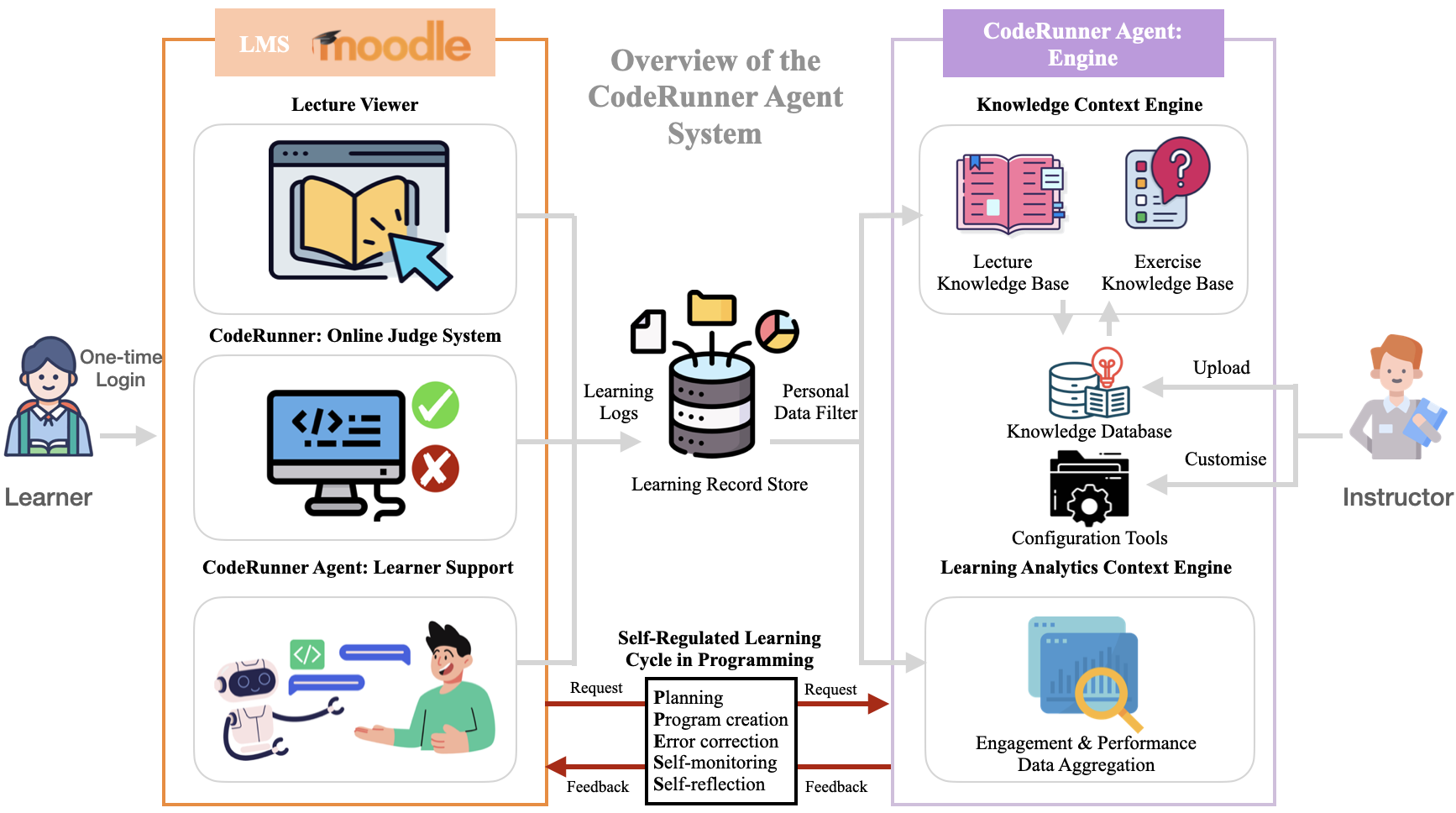
The integration of artificial intelligence (AI) into educational settings has the potential to revolutionize the way students learn knowledges and skills. Large language models (LLMs) possess unique advantages in this domain owing to their advanced natural language processing capabilities. They can offer real-time feedback and interactions that are sensitive to the individual’s learning context, understanding level, and specific challenges (Darvishi et al., 2024).
However, a common concern is that learners may rely too heavily on the LLMs response and are used to getting answers directly without learning processes (Becker et al., 2023). It will make the learners lose learning opportunity to develop their problem solving and metacognitive skills (Prasad & Sane, 2024). This harmful effect becomes more serious in the introductory programming in university since it’s a challenging process in programming learning for freshman students.
Consequently, the key question is: how can LLM be integrated into introductory programming learning by avoiding its harmful effects?
To solve this problem, it calls for an individual-level adaptive scaffolding for self-regulated programming learning to gradually transfer the regulation control from AI to students.